First make sure the live lineup is safe and true
A data repair comes after player supervision and the real substitution. If the screen currently disagrees with play, establish who is actually active and correct the current lineup when safe. Do not leave the next decision wrong while trying to reconstruct an earlier second.
Then separate known facts from estimates. An official timeout or written clock note may support a precise elapsed time. A vague memory that the change happened earlier does not. Use the correction tool only for a time you can defend.
Open the reconstructable action history
Open Tools, then Undo & correct. The history lists confirmed substitution events and their elapsed playing times. Elapsed time excludes paused intervals, so translate an official-clock note carefully if your tracking convention paused differently.
If the panel says there is no reconstructable substitution evidence, the match cannot be retroactively rebuilt through this tool. Older records created before journal evidence exists may still have totals, but that does not create a safe event history. Keep an external note instead of fabricating one.
Preview a corrected elapsed time
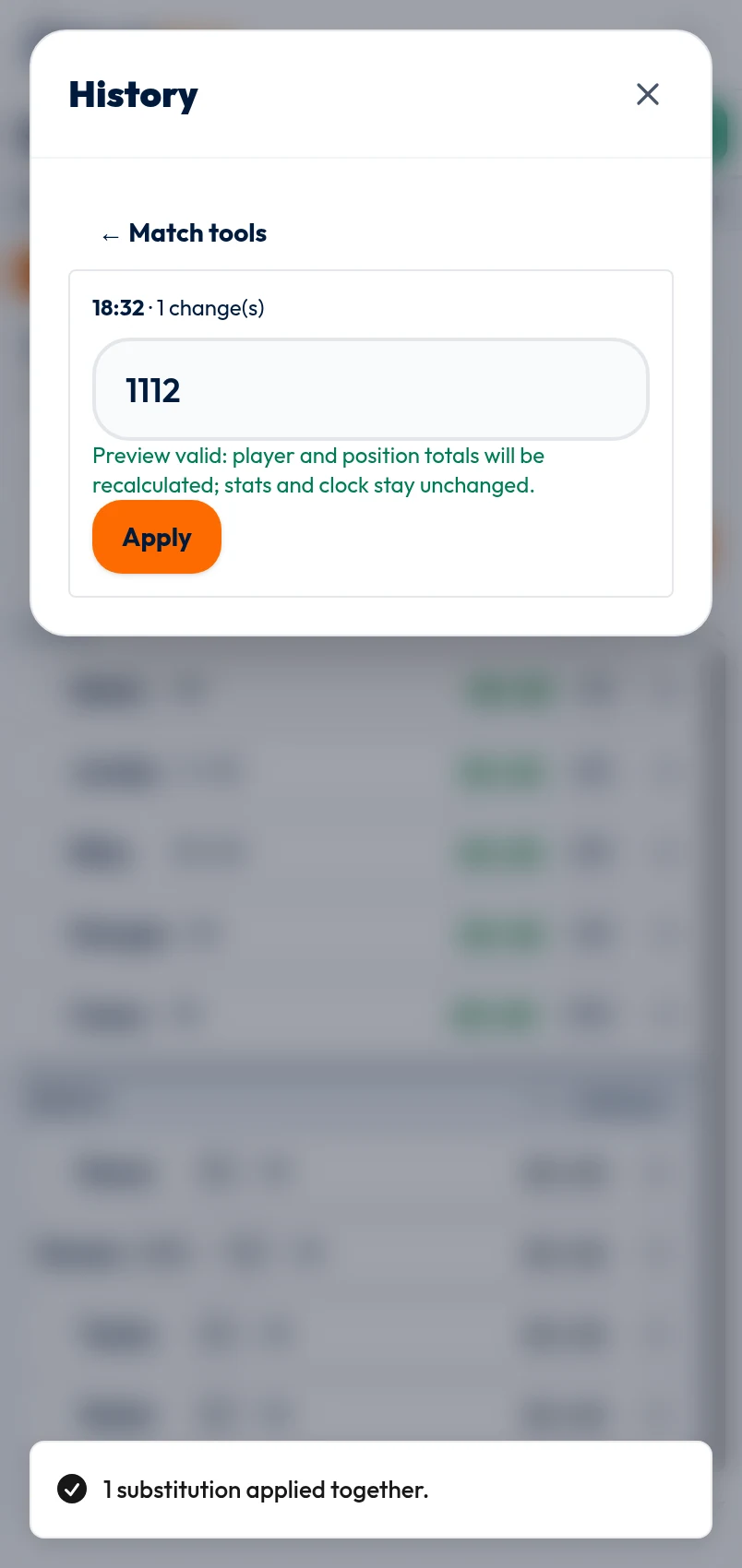
Open the action for the affected event: the Free Tracker button is Correct, while the connected match button is Correct time. Enter the corrected elapsed second. The preview validates whether the event can move there while preserving a coherent sequence. Read any error rather than trying nearby numbers until one happens to pass.
A valid preview states that player and position totals will be recalculated. The live match clock, scoreboard and quick stats remain unchanged. This is important: moving a substitution does not claim that a scoring event also occurred at a different time.
After comparing old and proposed times, choose Apply in the Free Tracker or Apply correction in a connected match. Return to Total and any position detail to check the result. If the event changes plan assumptions, review or regenerate the proposal.
Undo only the latest eligible substitution
Undo is intentionally narrower than correction. Only the latest valid substitution event can be undone, because removing an earlier event could invalidate every later lineup transition. Choose Undo last, read the confirmation, and verify the affected players.
Undo recalculates player and position totals while preserving score, stats and the clock. It is appropriate for a confirmed tap that did not happen in reality, not for a real substitution whose timestamp is merely late. For the latter, use Correct locally or Correct time in a connected match.
After undoing, record the real current lineup through the normal substitution controls if needed. Do not assume undo creates the opposite future swap or restores a queued plan group.
Understand what the repair does not change
The correction journal is not a general timeline editor. It cannot invent missing events, alter the official match duration, move quick stats, rewrite score changes, or edit arbitrary old matches. Unsupported evidence remains a limitation of the record.
Availability and planned rotations are also separate. If an injury caused the mistaken entry, mark the player's current availability and review the remaining plan after repairing the substitution. A corrected history does not make an unavailable player eligible.
Connected changes must save successfully; do not treat a visible optimistic update as durable if a save error remains. In the Free Tracker, data remains local to this browser, so retain a fallback for important matches.
Review the recap without hiding uncertainty
At full time, pause and inspect Total, position buckets, score and stats. Finish only when the available record is as accurate as the evidence allows. If an unsupported interval remains uncertain, note that limitation in your coaching review instead of distributing false precision.
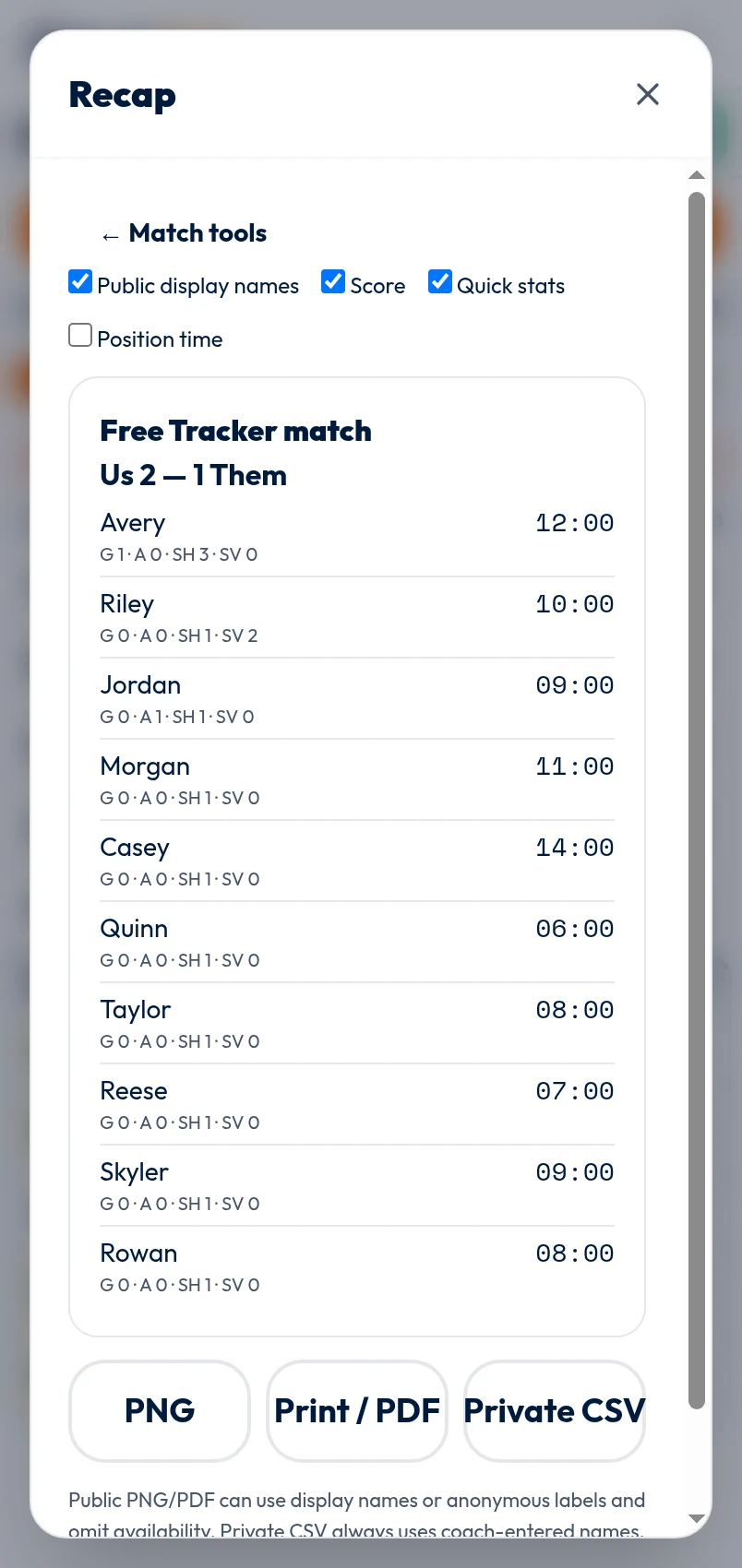
Recap & exports can create a public PNG or Print / PDF and a private CSV. Public output excludes correction details and availability, so it cannot explain every repair decision. Private CSV remains coach data, and downloaded copies cannot be revoked.
A safe correction is transparent: it changes only the timing evidence it can reconstruct and leaves unrelated measurements alone.