
Ask a coaching question before opening a chart
A playing-time report is most useful when it helps you choose what to observe or practice next. It is much less useful as a scoreboard for ranking children. Start with a question such as Who had little time in the role we practiced? or Did our rotation give everyone a meaningful opportunity to try the new task?
Recorded minutes describe exposure, not learning by themselves. A player may spend ten minutes in a role without receiving the ball often, or make useful movements that your quick stats never count. Use the report to focus your attention, then combine it with what you actually saw.
The worksheet below is an original planning method, not a proven intervention or a league requirement. BenchClock supplies recorded inputs and calculations; it does not diagnose a player's ability or prescribe the next drill.
Check the sample before interpreting the result
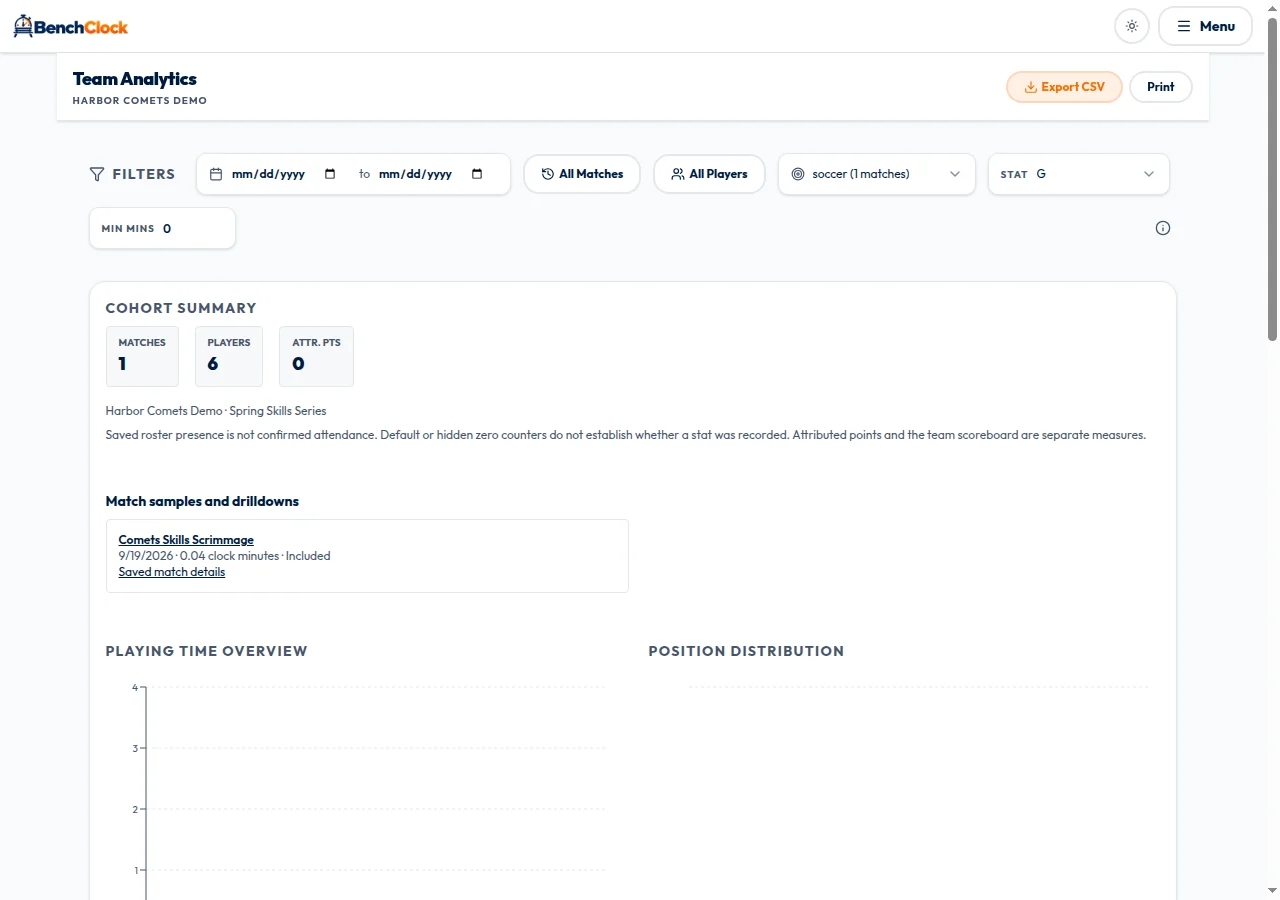
Connected Team Analytics requires authorized coach or assistant access. It uses qualifying finished matches that were actually started. A prepared fixture, unfinished match, or local rehearsal is not interchangeable with a completed connected match in that report.
Choose a date window and match set that fit the question. For a review of last weekend, do not leave several months selected simply because more data looks impressive. Check the selected match count and any incompatible-match warning before looking at individual players.
Configuration groups matter. BenchClock combines records only when their complete saved sport, stat, tracking, and position definitions match. If position tracking changed mid-season, a smaller compatible set may answer your question more honestly than an attempted all-season total.
Also distinguish roster presence from attendance. A saved roster containing a player does not prove that player attended or was available to play. Average minutes per rostered match and appearances answer different questions: an appearance requires recorded field minutes greater than zero.
Review opportunity before output
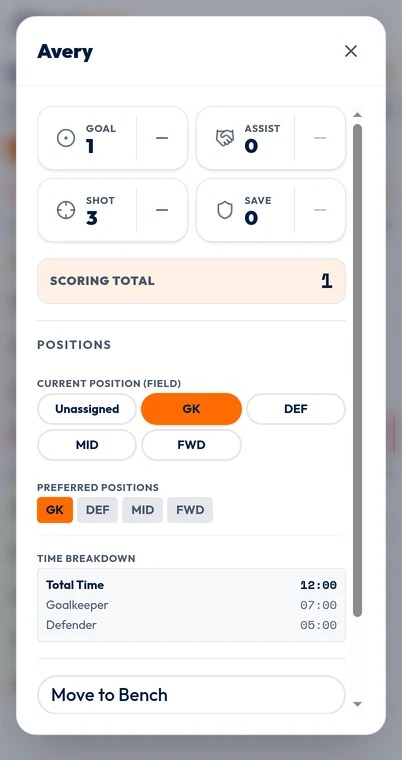
First inspect total field minutes and role exposure. Then look at the manual events you chose to track. This order prevents an obvious mistake: assuming fewer goals or rebounds indicates a problem when the player had much less opportunity in the relevant role.
Playing-time percentage uses the player's field minutes divided by saved match-clock minutes for the selected matches whose rosters contain that player. Position percentage uses the player's own field minutes as its denominator. These percentages are not interchangeable, and neither is an attendance percentage.
Consider the quality of the position record. Minutes marked Unassigned or Not tracked should stay visible as uncertainty. If half a player's active time has no useful role assignment, avoid a confident claim that they spent the whole game in defense.
Finally ask whether your manual stats cover the skill you care about. A tally of goals cannot tell you how often someone scanned before receiving, supported a teammate, or understood a defensive instruction. For those questions, plan a direct observation at practice rather than extracting a conclusion from the wrong measure.
Work through an opportunity gap
Imagine two fictional players across two selected 30-minute matches. Alex recorded 42 field minutes, including 30 at defender. Morgan recorded 24 field minutes, including 6 at defender. The total field-minute difference is 18; the defender-exposure difference is 24. Those are observations, not explanations.
Before planning anything, check context. Was Morgan absent for part of one match, returning from an injury, or intentionally playing another role? Was the recorder consistent? If Morgan attended both sessions and wanted more defender practice, the report suggests an opportunity question worth addressing.
A practical next session could give Morgan an early turn in a small-sided defending activity, with a coach observing body orientation and support decisions. Alex can receive a different constraint or try the opposite role. You are not assigning a punishment to one player or a reward to the other; you are allocating useful practice opportunities.
Do not write Morgan needs exactly 24 extra minutes into the plan just because that was the recorded gap. Match minutes and practice minutes are different environments. Choose an appropriate activity duration based on the session, the players, and their readiness, not a mechanical debt-repayment calculation.
Use a five-part practice worksheet
Keep the worksheet separate from the report so that your interpretation is not mistaken for a recorded fact. One row per question is enough. Start with the observation, list a plausible alternative explanation, choose an activity, identify what you will watch, and set a review point.
For the fictional example, the observation is limited defender exposure. The alternative explanation is availability or missing position assignments. The activity is a short, coached defending rotation. The observation target is whether the player can recover into a useful supporting position. The review point is the next practice and the next accurately recorded match.
That sequence forces you to say what evidence would change your mind. If the next session shows the player understands the role but had simply lacked match opportunities, the response differs from what you would choose for a skill that still needs teaching.
- Recorded observation: state the count, minutes, or role exposure without a personality judgment.
- Context to verify: availability, task, opposition, or recording limitations.
- Practice response: one activity or rotation change you can actually deliver.
- Observation target: one visible action that matches the coaching question.
- Review point: when and how you will reassess the plan.
Discuss the plan without turning children into rankings
If you discuss a player's opportunities with a family, explain the scope and limitations of the record. Use an individual example rather than sending a full-team comparison by default. A report can support a calm conversation, but it cannot settle every question about fairness or replace the team's stated participation policy.
Do not promise that a particular rotation or drill will improve performance because the chart suggested it. The report is a prompt for a coaching decision, and the decision should be reviewed. If recording quality is poor, improving the recording routine may be the first action.
The connected analytics screenshot comes from one synthetic demo match lasting only a few seconds, with no recorded events. It documents the report controls and sample disclosure, not a meaningful player comparison. Open your own authorized analytics only when you have a useful set of finished matches, choose one question, and leave with one practical change.