
Define the promise before you make the plan
Equal playing time is a numerical target: eligible players receive the same amount of participation over a stated period. Fair playing time is a policy judgment about opportunity, safety, availability and the purpose of the team. The terms can overlap, but calling a decision fair does not explain how it was made.
Start with your competition’s current participation requirements and your club’s policy. They take priority over a generic rotation idea. Policies vary by sport, age and program; there is no universal percentage this guide can responsibly apply to every youth team.
Then state the promise in plain language. ‘Approximately equal minutes across this match for players available throughout’ is different from ‘balanced opportunity across the season.’ If you choose a longer review period, explain how you will prevent the same children from repeatedly receiving the short end of individual games.
Safety remains a boundary. A player who is injured, unwell or asking to stop should not be sent back solely to satisfy a spreadsheet. Apply your organization’s health and safeguarding procedures and record only the participation context necessary for your review.
Calculate the minutes budget before assigning players
Here is a fictional planning example, not a league rule: a 40-minute match with seven active places and ten available players. The total budget is 40 × 7 = 280 player-minutes. Dividing by ten gives an equal target of 28 minutes each.
Divide the match into eight planning blocks of five minutes. Each block contains seven player-slots, so you have 56 slots. Ten players cannot each receive exactly the same whole number of slots: six players can receive six slots, or 30 minutes, while four receive five slots, or 25 minutes. The total is 6 × 30 + 4 × 25 = 280.
That five-minute gap is a consequence of the chosen block size, not evidence that exact equality is impossible. You could use smaller blocks or uneven intervals. But more changes may increase sideline workload, and actual substitution opportunities may not match the plan.
Write a feasible roster-specific schedule, then check its column totals. If you retain the five-minute blocks, rotate who receives the extra block at the next comparable match where policy allows. Do not promise exact equality while using a schedule that mathematically cannot provide it.
Adjust the denominator when availability changes
Suppose the same match begins with nine players, and a tenth arrives after ten minutes. Reusing the original 28-minute target without discussion hides a real decision: whether you seek equal final totals or equal access to playing opportunities while each child is available.
Under a proportional-availability approach, the first ten minutes offer 70 player-minutes among nine players, about 7.78 each. The remaining thirty minutes offer 210 player-minutes among ten players, or 21 each. The original nine would target about 28.78 minutes apiece and the late arrival 21. The total still equals 280.
These decimals are planning arithmetic, not instructions to make substitutions at hundredths of a minute. Turn them into a practical schedule and follow your stated policy. Another permitted approach might seek closer final totals; neither approach should be introduced as a surprise to justify a decision afterward.
Distinguish availability from punishment. Travel disruption, illness or a family circumstance may be outside a child’s control. If attendance affects selection, it should do so through a published, age-appropriate club policy, not an improvised penalty imposed during the game.
Equal totals do not guarantee equal opportunity
Two players may each log 28 minutes but experience very different roles. One could spend most of the match in goal, while another rotates through several outfield positions. Whether that meets your developmental goals depends on what you promised and what is appropriate for those players.
Consider a separate role-opportunity review. Ask who has had a chance to try a role, who requested a change, and who needs a supported introduction in practice before using it in a match. Do not force identical role distributions without considering readiness, willingness and safety.
Optional position tracking can make those conversations more concrete. It records the labels and intervals you entered; it does not measure confidence, learning or tactical quality. A player’s low scoring total also does not prove that their minutes were less valuable than a teammate’s.
- Minutes: how long was the player recorded as active?
- Roles: where was that time recorded?
- Availability: when could the player safely participate?
- Context: which interruptions or missing entries affect the interpretation?
Explain the policy, not a public ranking
Before the season or tournament, share the target, review period and genuine exceptions. A useful statement might be: ‘We plan balanced participation for available players, review both totals and roles, and adjust for safety and the competition’s requirements.’ Add the actual participation promise your club authorizes rather than relying on that general sentence alone.
After a difficult match, discuss the individual child privately. Use their record and the relevant circumstances instead of circulating a ranked table of teammates. Another child’s health, family situation or disciplinary context is not yours to disclose as an explanation.
If the record reveals an oversight, acknowledge it and make a concrete next-match plan. Do not invent a tactical reason to defend every imbalance. Conversely, do not promise compensating minutes that conflict with safety, eligibility or your league’s per-match requirement.
Review the evidence without pretending it is perfect
Compare recorded totals against the available budget. If seven players were active for forty tracked minutes throughout, their combined participation should be about 280 minutes. A short-handed interval or a paused clock changes that expectation. Small display-rounding differences are not the same as a large recording gap.
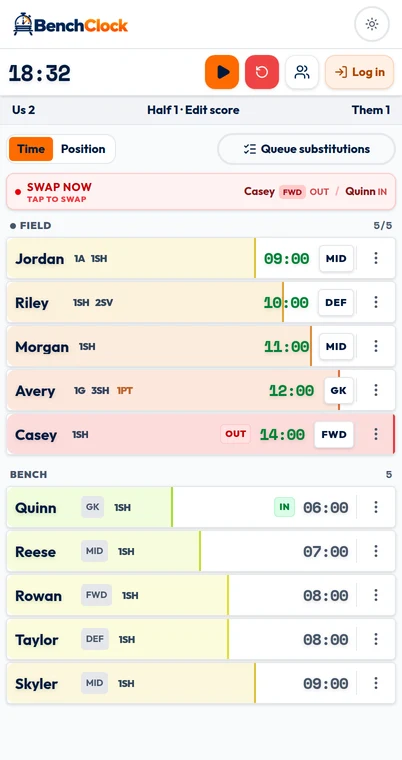
BenchClock can help record individual time and optional positions, but the coach still defines the policy and enters the changes. The screenshot below shows local source inputs with fictional demonstration players, not the numerical example’s completed report. Connected analytics require sign-in and appropriate permissions.
Open /app if you want to rehearse the recording side. Start with a fictional roster and one clear fairness target. The useful outcome is not a perfectly symmetrical chart; it is a plan you can explain, a record you can trust within its limits, and a specific adjustment when reality differs from the promise.