
Start with a budget, not a list of substitutions
A fair rotation needs three inputs: the available players, the number playing at once and the measured match duration. Multiply on-field places by match minutes to find the player-minute budget. Divide by available players for an equal-share reference. Then check whether your goalkeeper plan, player availability and local rules make that reference feasible.
For example, seven places across 40 minutes create 280 player-minutes. Ten players could receive 28 each. Nine places across 48 minutes create 432 player-minutes; eleven players average about 39 minutes 16 seconds. Those durations are fictional planning examples, not prescribed youth match lengths.
Equal totals and fair opportunities are related but not identical. A player can receive an equal total almost entirely in goal while a teammate receives outfield experience. Decide whether your policy concerns total participation, outfield time, role variety or a combination. Explain that policy before the season rather than inventing it when someone asks about a short spell.
A 7v7 plan with ten players and one fixed goalkeeper
Suppose your fictional 40-minute match uses one goalkeeper for the whole match. That leaves six outfield places for nine outfield players: 240 outfield player-minutes, or 26 minutes 40 seconds each in an exactly equal allocation. The goalkeeper's 40 minutes must be discussed separately; comparing all ten totals to 28 would conceal your deliberate role constraint.
Label the nine outfield players A through I on a paper planning sheet. Use six blocks as a simple structure. In block one, A/B/C rest; in block two, D/E/F rest; in block three, G/H/I rest. Repeat that sequence for blocks four through six. Each player rests twice and plays four blocks. With exactly equal blocks, outfield participation is equal.
Real substitution opportunities rarely land at 6:40 intervals. For a usable approximate 40-minute schedule, try block lengths of 7, 7, 6, 7, 7 and 6 minutes, subject to legal substitution opportunities. A/B/C and D/E/F each rest for 14 minutes and play 26. G/H/I rest for 12 and play 28. You can see the two-minute difference before kickoff rather than discovering it afterward.
Treat the short-block allocation as a remainder to manage, not a hidden privilege. Rotate which group receives the longer playing total next time, or use actual totals to adjust a later spell if practical. Do not sacrifice a safe, orderly change just to hit a theoretical timestamp.
A 9v9 plan with eleven players: make the remainder visible
Now suppose a fictional 48-minute 9v9 match has a fixed goalkeeper and ten outfield players, A through J. Eight outfield places create 384 outfield player-minutes. Each outfield player would ideally receive 38.4 minutes. Two players rest at any time, so an easy starting structure is six eight-minute blocks.
Use bench pairs A/B, C/D, E/F, G/H and I/J for the first five blocks. Everyone has then rested once. The sixth block needs another pair: if A/B rest again, they finish with 32 minutes and the other eight players finish with 40. The sum is correct: 2 × 32 + 8 × 40 = 384. The eight-minute gap is also real and should not be called equal.
One option is to divide that final eight-minute bench allocation into shorter pieces among several pairs, if legal opportunities and coaching capacity allow it. Another is to accept a documented single-match difference and plan to redress opportunity later, provided that approach fits your team's policy. A minimum-time rule in your league may rule out either approach; check it before adopting the plan.
This example explains why neat pairs do not always yield neat equality. Roster arithmetic, not a player's perceived usefulness, creates the leftover block. Putting the remainder on paper makes the choice visible and easier to discuss.
Rebuild the plan when attendance changes
An absent player changes the denominator. In the 7v7 example, if only eight outfield players attend, six places over 40 minutes give each an equal-share reference of 30 minutes, not 26 minutes 40 seconds. There are now two resting players at a time rather than three. Strike out the old bench groups and rebuild them before the game.
Late arrivals require a different adjustment. Suppose a player becomes available with 16 measured minutes left. They cannot receive a 28-minute target in that match. Record their available window, offer an appropriate opportunity within it and avoid taking excessive minutes from others to chase an impossible total.
If your goalkeeper is also rotating, allocate that role explicitly. Name who is eligible and prepared to play there, when the exchange is intended and how their outfield opportunity changes. A list of bench turns alone cannot guarantee goalkeeper coverage. Injuries, discomfort and safety decisions override a spreadsheet target.
Use actual totals to repair the plan, not erase it
BenchClock's soccer tracker can help you see who has accumulated more or less field time and offers substitution guidance. It does not generate these six-block plans or enforce your league's participation rules. Prepare the rotation yourself, then compare it with the live record when substitutions are permitted.
At a planned change, check who actually needs rest, who is available to enter and whether the intended roles remain covered. Enter the real swap rather than the intended one. If play delays a change by two minutes, keep those two minutes in the record. The next decision should use actual totals, not a rewritten version of the original plan.
When coaching alone, make the plan less intricate. Two or three clearly named changes at a permitted stoppage may be more reliable than repeated small adjustments that distract from supervision. A plan that is slightly uneven but accurately followed can be reviewed; an elaborate plan recorded inaccurately cannot.
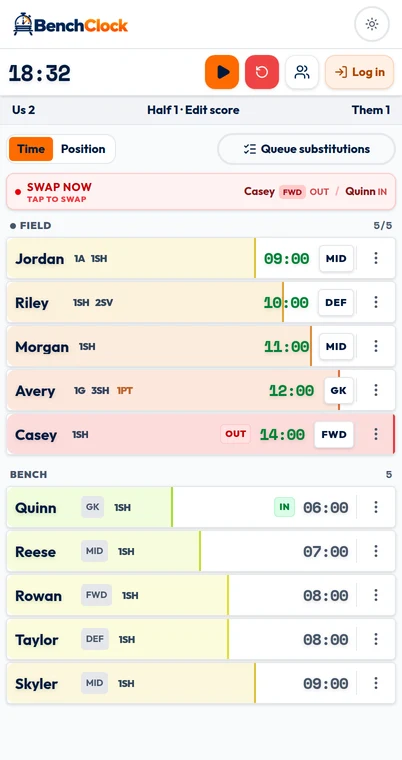
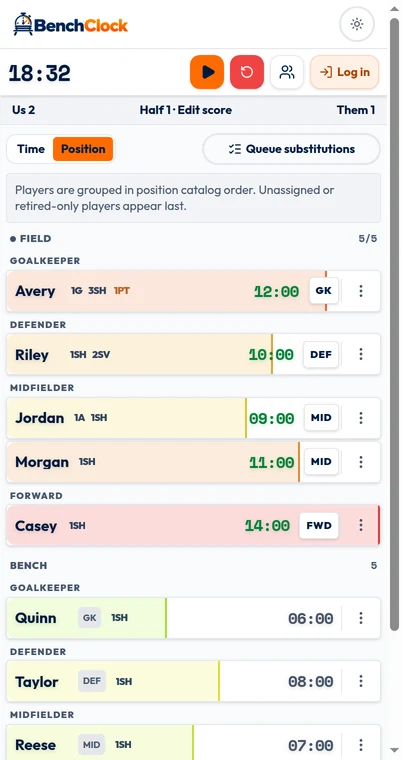
The Time and Position controls change how each Field and Bench list is displayed; they do not move a player, assign a role or alter anyone's total. Time order supports the timing-based guidance. Position order groups Field players by their current assigned position, following the active position catalog's order. It groups Bench players by the earliest active catalog position found among their preferred positions. Within a group, players retain stable roster order.
Unassigned Field players and Bench players with no active preferred position appear last. A player whose only relevant position is retired also falls into that final group. If position tracking is off, everyone appears under Unassigned in stable roster order. Use these headings to check role coverage, but do not mistake a preferred Bench grouping for a live assignment.
- Before kickoff: confirm attendance, goalkeeper plan, local rules and budget.
- At each change: verify outgoing names, incoming names and role coverage.
- Between periods: compare actual totals with the intended opportunity policy.
- Afterward: note unexplained gaps and assign a specific next-match adjustment.
Make the policy understandable without promising perfection
Tell families whether you are aiming for similar minutes within each match or reviewing opportunity over an agreed period, and explain any role constraints. Do not publish a child's injury explanation or use public comparisons to pressure them. A concise team policy is more useful than presenting a live leaderboard of who has played least.
To rehearse the recording side, open /app and try a fictional roster with your real field limit. Check how long it takes to enter one set of changes. Keep the paper rotation available as a backup, and let the tracker answer the narrower question it is designed to answer: what time have you recorded so far?